
Two-Eyed Seeing as an Ethical Systems Orientation
Two-Eyed Seeing is a foundational orientation that informs both my Ethical AI work and the Signature Vibrations™ Method.
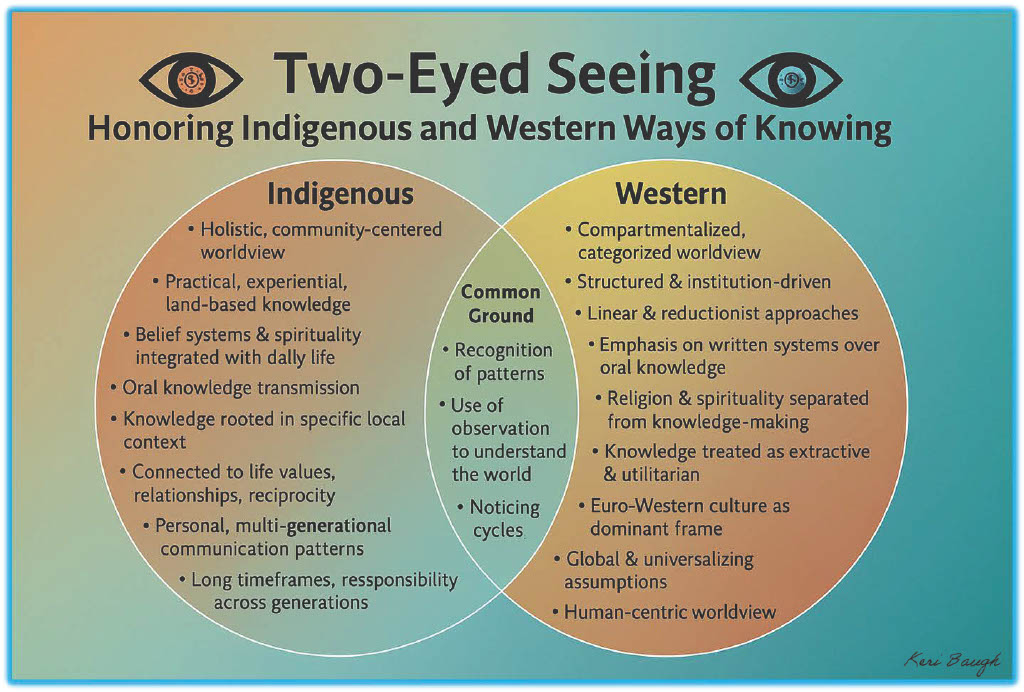
First articulated by Mi’kmaq Elder Albert Marshall, Two-Eyed Seeing calls for working with the strengths of Indigenous knowledge systems—relational, place-based, responsibility-centered—alongside the strengths of Western science—analytic, quantitative, and predictive. The aim is not synthesis or hierarchy, but co-presence with accountability.
In my work, Two-Eyed Seeing functions as a systems lens: it shapes how coherence is defined, how disruption is interpreted, and how resilience is evaluated over time.
Connection to Ethical AI
Within Ethical AI, Two-Eyed Seeing reframes harm and responsibility.
Many AI failures are described as technical—bias, drift, security gaps. A Two-Eyed Seeing lens makes visible what is often missing beneath those symptoms: relational integrity. Unclear authority, absent consent, and responsibilities assigned only after harm occurs are not technical oversights; they are ethical design failures.
Applied to AI systems, Two-Eyed Seeing means:
- Treating data as relational, not extractive
- Designing governance, consent, and accountability before deployment
- Valuing interpretability, care, and context alongside performance
- Recognizing communities and ecosystems as stakeholders with authority, not downstream impacts
Ethical AI, from this perspective, is not about adding safeguards after the fact. It is about ensuring that coherence is present before learning accelerates.
Connection to Signature Vibrations™ Method
The Signature Vibrations™ Method provides the structural expression of this orientation.
Two-Eyed Seeing informs how the method distinguishes between:
- Alignment (baseline coherence shaped by identity, regulation, and context)
- Coherence (how structure responds under disruption)
- Resonance (what persists as trustworthy signal over time)
Indigenous knowledge systems emphasize continuity, responsibility, and relational accountability across generations. Western systems science emphasizes diagnostics, modeling, and prediction. The Signature Vibrations™ Method holds both without collapse—allowing stress, disruption, and adaptation to be interpreted without losing meaning or integrity.
In this way, Two-Eyed Seeing is not separate from the method.
It is what makes resonance legible rather than assumed.
Ethical Research, Ethical AI, and System Durability
Across research, AI governance, and ecological systems, Two-Eyed Seeing supports a shared question:
Does the system remain coherent under pressure—and accountable to those it affects?
Rather than optimizing for short-term performance, this orientation prioritizes:
- Responsibility defined upfront
- Authority made explicit
- Care embedded in system design
- Durability measured over time, not moments
Two-Eyed Seeing is not an ethical add-on.
It is a way of designing systems—human, ecological, and computational—so that integrity is visible, coherence is testable, and resilience is earned.